I recently attended Automatica.it 2026 in Parma, the annual conference of SIDRA ( Società Italiana Docenti e Ricercatori in Automatica). During the event, I had the pleasure of chairing the session “Safe, Secure, and Resilient Control Systems” and presenting our research on “Homomorphically Encrypted Control”, developed within the Distributed and Dynamical Systems Research Group of the University of Udine.
Notice to students: office hours have been rescheduled to Thursday , from to . For any questions or further information, please contact me via email.
Our article, “Performance analysis of homomorphically encrypted closed-loop PI control with nonlinear anti-windup for anaesthetic drug administration”, has been presented at the IFAC World Congress 2026 in Busan, Republic of Korea. This work introduces a cloud-assisted, privacy-preserving closed-loop anaesthesia control system using the CKKS homomorphic encryption scheme to process sensor data directly on ciphertexts. It analyses and evaluates how executing non-linear operations within the encrypted domain impacts PI controller performance under anti-windup constraints.
The call for papers for the Special Issue “Distributed Systems: Algorithms, Methods, and Applications”, to be published in Mathematics (MDPI, Q1), is now open!
As part of the editorial team, I’m pleased to invite original research on: distributed algorithms and systems; information security, cryptography, and privacy-preserving methods; secure and distributed control; cyber-physical systems; critical infrastructure protection, cloud computing, IoT, and networked control systems.
The Special Issue welcomes theoretical, methodological, and application-oriented contributions that advance the state of the art in distributed systems and their emerging applications.
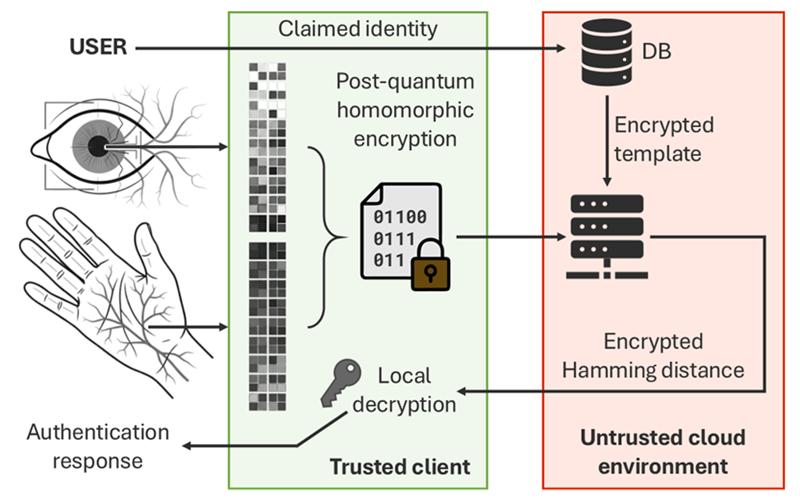
Our article, “A Post-Quantum Cryptography Enabled Feature-Level Fusion Framework for Privacy-Preserving Multimodal Biometric Recognition”, has been published in Cryptography (MDPI Open Access). This work introduces a quantum-resilient and privacy-preserving framework for multimodal recognition, capable of seamlessly integrating any binary-encoded biometric modalities through feature-level fusion, thereby ensuring that all sensitive data remains encrypted under the CKKS homomorphic encryption scheme throughout the entire process.
Selected Publications
A Post-Quantum Cryptography Enabled Feature-Level Fusion Framework for Privacy-Preserving Multimodal Biometric Recognition